
Events: Battenkill Race 2025
(2025) To throw the term “flahute” around is reserved for extreme occasions, and the 2025 Battenkill Race earned itself the label. After a ten-year hiatus, Battenkill Race (formerly known as Tour of the Battenkill) returned to the calendar, pivoting amidst a concerning trend of disappearing races. One of the three 2025 events we registered for, the focus went from being competitive to simply finishing the ordeal.
“Flahute” is a Flemish phrase encapsulating the hardest of the hard riders. These are the steely personalities lining up in the driving rain, the cold temperatures, and the slick roadways. Part of the qualification for earning the revered description is taking part in long events in the least possible comfortable conditions. For those seeking the coveted term, Battenkill Race’s setting was about as authentic as possible.
I rolled out of bed early race morning and stepped outside my Saratoga Springs hotel room just in time to watch the race horses clop-clop down the road on their way to the race track across the street. It was raining. It had rained heavily all night. In fact, it had been raining all week. The jockeys seemed at home as they socialized with each other. I watched a track employee in full rain gear, stop traffic to allow the horses to cross. He then scooped the horse poop off the road and authorized traffic to resume. Horses have the right of way in Saratoga Springs. I loaded up the team car, waved to the pooper scooper, and made the forty-minute drive to Cambridge, NY, and the starting line of the Battenkill Race.
Scroll through our events page long enough and one of the first articles recaps the 2015 Tour of the Battenkill. Battenkill - ‘kill’ in Dutch means riverbed, so Battenkill River is redundant, it translates to Batten River - has always held a special place in numerous competitive cyclists’ hearts. In late 2015, Anthem Sports sold the Tour of the Battenkill. The event continued under a fondo format for nine years before Anthem Sports purchased back the event. As soon as registration opened, I punched my ticket to Cambridge. While the event had returned, the day would appear different than in the past.
The Tour of the Battenkill earned its moniker as the Queen of the American Classics. It once held UCI status. It once hosted three thousand competitors, all racing for prizes. In the early years, registration servers were flooded the exact minute the pro/am event opened. Battenkill was ahead of the gravel curve, creating an event sporting a large percentage of unpaved roads in Washington County, NY. There were referees for each 100 km amateur race plus a lead out car and follow truck holding extra wheels for competitors. The Tour of the Battenkill was certainly the Queen of American Classics, but it may have reached the level of the Queen of American races at its zenith. For 2025, nearly all these little details returned in some form or another.
What joined the event card were unique cycling events. To entice participants from the last few years, Battenkill Race hosted fondos of varying distances. There were kids races as well. Entrenched in many fields, gravel bikes appeared, a type of bike in its infancy a decade ago. Instead of the Battenkill Race being only a competitive day for roadies, it became a cycling celebration that would be hard to dampen. Until the rains came.
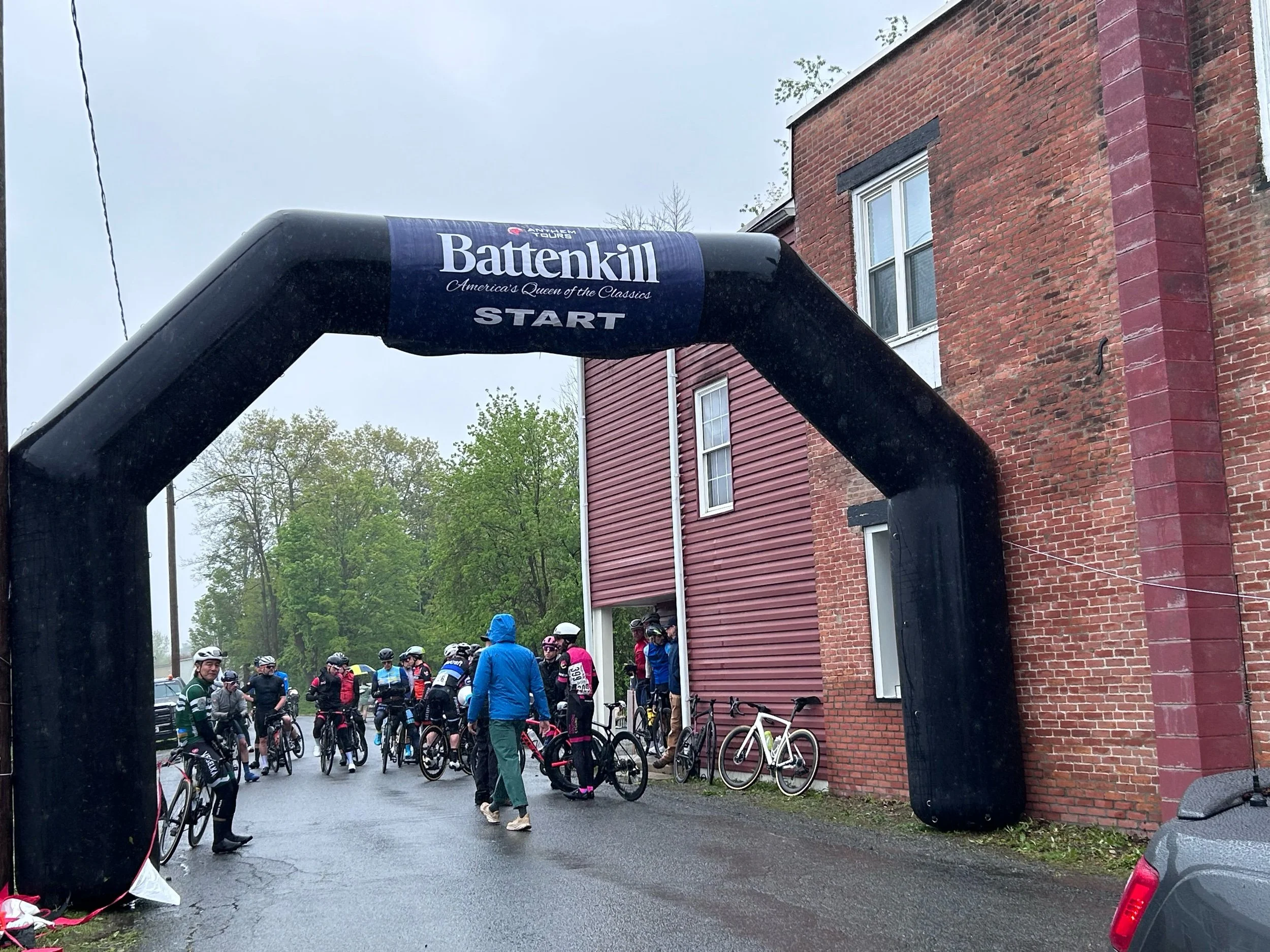
The return of Battenkill hosted well over one thousand cyclists who purposely lined up on Broad Street in downtown Cambridge, NY, under driving rain. It was cool enough to play havoc on attire. I geared for warmth in the first two hours and likely over dressed for the remainder of the race. This is precisely what happened. Dieter Drake, race director, emphasized visible race numbers. Riders fidgeted with rain capes to show numbers as the one minute warning was called out. The pitter patter of rain drops could be heard once more after the announcement. “The conditions are the same for everyone,” I reminded myself before rolling out with my field. Ten feet in, the slick railroad tracks were overcome without drama. This was going to be a good race group.
Like Anthem Sports’ other event, Tour of the Catskills, Battenkill Race features a slightly downhill start for nearly seven miles. These opening miles are perfect for dialing in the day. Nutrition is explored amidst the pack. Things will get dicey after the covered bridge, but for now the group glided along standing water, sending up plumes of spray. Everyone rode as close as possible for warmth but as far as possible in case of catastrophe. Luckily everyone kept the rubber side down.
The field slowed the roll to approach the covered bridge, arguably due to the pinch point as well as the darkness within. It was nice not to be rained on, even if briefly. Battenkill veterans knew what to expect after the bridge: a few punchy climbs and the first gravel sector. This is where the race begins, and this year was no different. Except the gravel sector was unlike any ever experienced.
Actually all the gravel sectors were unlike any experienced. These gravel roads differ from those in southeastern Pennsylvania and western New Jersey. Today’s unpaved roads appeared slick but firm. The relentless rain had saturated the top levels of the road. Typically firm and fast, the Battenkill gravel sectors were mushy and spongy, sapping any power. What appeared to be pebbled tracks were just as absorptive as the middle of the road. Every inch of a cyclist’s facade was covered in soot. In no time at all, we could feel that flahute ranking sliding into our jersey pocket. Juniper Swamp, a steep gravel climb that hits 14% early into the race, was a struggle. Stand up and risk losing traction or remain seated and feel the gravel reaching up and holding forward motion ransom. The bike began to protest by making unique noises. Grinding, clicking, and generally loud unhealthy sounds emanated from the mechanism. “Flahute!” I kept thinking. This was hard, but Battenkill’s profile was the least climbing in its history. What could be harder than this I asked. Every other year, I suppose.
Ferguson Road will haunt me for years to come. It appeared immediately after the second feed zone. It came as an innocent right hand turn after the route went up through a cow farm. What Washington County revealed to the Battenkill Race was something out of a disaster. The road was deep thick mud of toothpaste consistency. There appeared more than one hundred potholes of varying distances plus two gigantic puddles that likely concealed crocodiles. I avoided every divot as best as possible. The roadway was full of bottles, likely from the front groups flying into Ferguson, fresh off the feed zone, and everyone taking evasive maneuvers to remain competitive. I caught a rider later who said, “I feel bad for the roadies who had to go through [Ferguson]. Oh! You’re one of the roadies.” The mud was deep enough to conceal the inner edge of the deep dish rims. Years, I tell you, years.
What Battenkill does really well is provide remarkable scenery for those who were shot out the back. This region of New York is simply cycling paradise. The views are beautiful. There are rolling hills that defy imagination. At one point a city skyline was framed by the roadway and a break in the trees. The bike and I might have been caked with mud, but I couldn’t help wanting to go on and on forever riding these roads. We zipped down one descent much to the entertainment of an Amish man driving a buggy. How many unique experiences can happen in a single race?
With an hour to go in my day, the rain stopped. The clouds loosened and the sun shone down in that blinding way it tends to do after a soaker. My base layer started cooking me. I had consumed only half of a water bottle and no nutrition. The bottles were caked with grime and I was too focused on maintaining control of the bike that I never went into the back pocket for gels or pictures. I did snap a single picture from the summit of Juniper Swamp aftering having to tighten the water bottle cage bosses.
Battenkill excels in the dedication of its volunteers and first responders. Numerous parts of the course had ambulance presence. Major intersections featured police officers or state troopers. The remaining roads had volunteers eagerly guiding riders on their way back to Cambridge where the finish party was getting started. The entire event felt safe; the riders were well cared-for.
At one point I thought I had caught the race in front of me. It turned out to be some of the early morning fondo riders. Even their event had a moto for any issues. These riders were also caked in mud and navigating the same conditions. They hammered on as race after race went by. Eventually it was my turn to be overtaken. My old race category came rampaging by. I wanted to shout out my credentials of the past for some recognition, but they raced over the next climb and were never seen again. Things have changed at Battenkill. I’ve changed, too.
Eventually the climbs were summitted, the mud absorbed, and the flat sections raced before the final kilometer banner came into view. A volunteer manning an intersection involving the race course and cemetary entrance said, “Not far now.” I thought, “The cemetery? Or the finish?” I rolled through the finish with the rider who had commented about road bikes and Ferguson Road. He nabbed a top twenty. I finished one spot behind him. Meanwhile our race had nearly a dozen DNFs, but dozens of DNSs. Toward the end, nearly every intersection had a participant waiting for the broom wagon to collect them.
There is a moment after a race like Battenkill where there is uncertainty. Where does one begin the packing up process when the rider, the clothes, the bike, and everything else is covered in mud? Luckily another finisher located a hose at the local high school. Word got out and people got to work making the bikes somewhat clean. I never entertained the idea of leaving Battendirt on the bike as they do in Roubaix. Shoes came off, full water bottles were chugged, there was pacing followed by changing into regular clothes. The legs had been hosed off with freezing water. The back was wrenching in agony.
The return trip home was full of recounting the hundreds of experiences from the Battenkill Race. It didn’t seem real. From the deepest mud ever ridden to the calf cramp caused by a failed attempt to unclip from the pedals at the finish, nothing seemed anchored in reality. How did I finish the race with such challenging conditions? I started thinking of all the ways Battenkill had changed. Then the nostalgia kicked in and there was immense thankfulness that some things remained the same.
In recent events, I opted to cut the course or take the shortcut. I wondered if this was the new norm for me - to opt out of suffering that used to give me so much joy. In a small town in upstate New York, I rediscovered that some things had changed in Battenkill, but that pursuit of being a hard rider remained the same. “Flahute,” I mumbled on the New York Thruway headed home. Even if I gave myself the designation, I think I earned it. That, and at least I didn’t wear white socks.